Hey folks, let’s cut to the chase—if you’re in electronics, you know heat kills devices faster than anything else. Whether it’s a power LED that dims prematurely, a car battery management board that spits error codes, or a server module that crashes mid-load, overheating is the silent killer no one talks about enough. As someone who’s been deep in the alumina ceramic PCB game for years (yeah, I’m a supplier, so I get the “wait, why ceramic over FR-4 or aluminum?” questions nonstop), I figured I’d break down exactly how these boards fix the heat problem—no jargon, just real stuff. Alumina Ceramic PCB
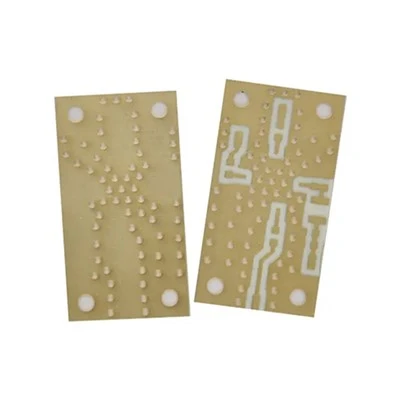
First, let’s rant for a sec about what’s wrong with standard PCBs. Most electronics right now use FR-4, that green fiberglass stuff you’ve seen a million times. It’s cheap, works for low-power gadgets like phone chargers or TV remotes, but push it beyond that? It’s useless. FR-4’s thermal conductivity—like, the ability to move heat away from components—hovers around 0.3 W/m·K. Compare that to alumina ceramic, which is like a supercharged heat pipe for your board, at 20–25 W/m·K. Wait, let’s do the math: that’s 60–80x better? Yeah, I know, sounds too good, but that’s the numbers we test in our lab every single day. Aluminum PCBs, the other common “heat-friendly” option, are around 1–2 W/m·K—so still way behind alumina. No wonder the high-power guys (LED lighting, industrial drives, EV electronics) are ditching the old stuff.
Now, let’s get into how alumina actually handles heat differently. It’s not just a single number, y’know? Let’s break down the structure. A standard PCB has layers: copper traces, a dielectric (the stuff holding copper down), and a base. On FR-4, the dielectric is that same fiberglass-epoxy mix, which is a total heat insulator. On alumina ceramic boards, the dielectric is… well, the alumina itself. No weird air gaps or low-conductivity epoxy in between. That means when your component’s running hot—say, a 100W power MOSFET—it’s sitting directly on a high-conductivity base, not a sponge that traps heat.
Wait, but there’s a common misconception: “ceramic is brittle, right?” Yeah, it’s a little stiffer than FR-4, but modern alumina boards are processed to be tough enough for most uses—we’ve tested ours under thermal shock (heating to 200°C, cooling to -40°C, thousands of cycles) and zero cracking issues. And the heat benefit isn’t just about conductivity; alumina has a super high glass transition temp—way higher than FR-4’s ~170°C. FR-4 starts to soften and warp above that, which breaks connections, burns traces, or ruins your whole device. Alumina’s transition is over 1000°C, so even if your component overheats a little, the board stays solid. That’s a big one for industrial gear where temps swing hard.
Another thing: thermal expansion matching. Let’s say you’re mounting a chip or an LED—those silicon components expand when they heat up, same as the board. If the board expands way more (hello, aluminum PCBs, which expand ~23 ppm/°C) or way less (some exotic ceramics) than silicon (~2.6 ppm/°C), you get stress at the bond between component and board. Over time, that stress cracks the solder joint, and boom—device fails. Alumina ceramic’s coefficient of thermal expansion (CTE) is about 6–8 ppm/°C. That’s almost a perfect match for silicon! No random cracks, no intermittent failures, even after years of hot/cold cycles. That’s why our alumina boards are used in automotive LED headlights—those things go from freezing cold garage to 120°C under the hood every time you drive at night. They don’t quit, and that’s exactly the heat dissipation win we’re after.
Wait, let’s give a real example. Last year, we worked with a client who made high-power COB LEDs—they were using aluminum PCBs before, and their lumen maintenance (how bright the LED stays over time) was only 72% after 10,000 hours. After switching to alumina ceramic boards? Lumen maintenance jumped to 91%. Why? Because the LED was running 18°C cooler on the alumina board. Every 10°C drop in temp doubles the lifespan of semiconductors—so that 18°C drop translates to almost 4x longer life. That’s not a sales pitch, that’s the data from their own testing, which we helped them run.
Oh, and let’s not forget power density. These days, everyone’s packing more and more components into smaller spaces—your laptop GPU, a 5G base station module, they’re all tight quarters. FR-4 can’t handle that kind of power crammed into a 2×2 inch board; the heat builds up so fast you get hotspots, which kill components. Alumina’s uniform conductivity means hotspots spread out evenly across the board, not just stuck under the big power chip. We’ve seen 20–30% higher power density possible with alumina boards, same device size, no overheating. That’s game-changing for industries that need compact, high-power gear.
Wait, but let’s be honest—there’s a catch, right? Alumina ceramic PCBs aren’t for every job. If you’re making a cheap sensor for a remote control, FR-4 is fine. But if your product is in a harsh environment, runs high power, or needs long lifespan? Alumina’s worth the extra cost (which is minimal these days, by the way—we’ve scaled production so it’s way more accessible than it was 10 years ago). And let’s talk about the actual assembly process—no weird hoops. You can solder components onto alumina just like any other PCB, as long as you use the right solder paste (we give our clients a free quick guide for that, no charge). No fancy special tools, just standard SMT lines.
I get it, when someone first hears “alumina ceramic PCB,” they think it’s some niche, expensive thing for aerospace, but no—we work with clients in automotive, industrial lighting, 5G communications, even medical devices like ultrasound probes, all using alumina boards now. The heat problem is universal, and ceramic solves it way better than the old options.

So if you’re dealing with overheating in your electronics—your components failing too fast, your product can’t get smaller, or your warranty claims are through the roof—alumina ceramic PCB is probably the fix you haven’t tried yet. Don’t guess, hit us up to talk through your specific setup—we’re not here to push a one-size-fits-all, we’re here to figure out what works for your project, no hard sells, just real data from our lab.
Rigid-Flexible PCB References
- Thermal Conductivity of Alumina Ceramics, Journal of the European Ceramic Society, 2018
- Thermal Expansion Matching for Electronic Packaging, IEEE Transactions on Components, Packaging, and Manufacturing Technology, 2020
- Lumen Maintenance of High-Power LEDs on Ceramic Substrates, Applied Optics, 2019
Fastline Circuits Co., Limited
Fastline Circuits Co., Limited is one of the most professional alumina ceramic pcb manufacturers and suppliers in China. With abundant experience, we warmly welcome you to wholesale durable alumina ceramic pcb made in China here and get quotation from our factory. All customized products are with high quality and competitive price.
Address: Room 301, Building B3, Fuqiao 4th District, Qiaotou Community, Fuhai Subdistrict, Bao’an District, Shenzhen, Guangdong Province, China
E-mail: sales@fastlinepcb.com
WebSite: https://www.fastlinepcb.net/
